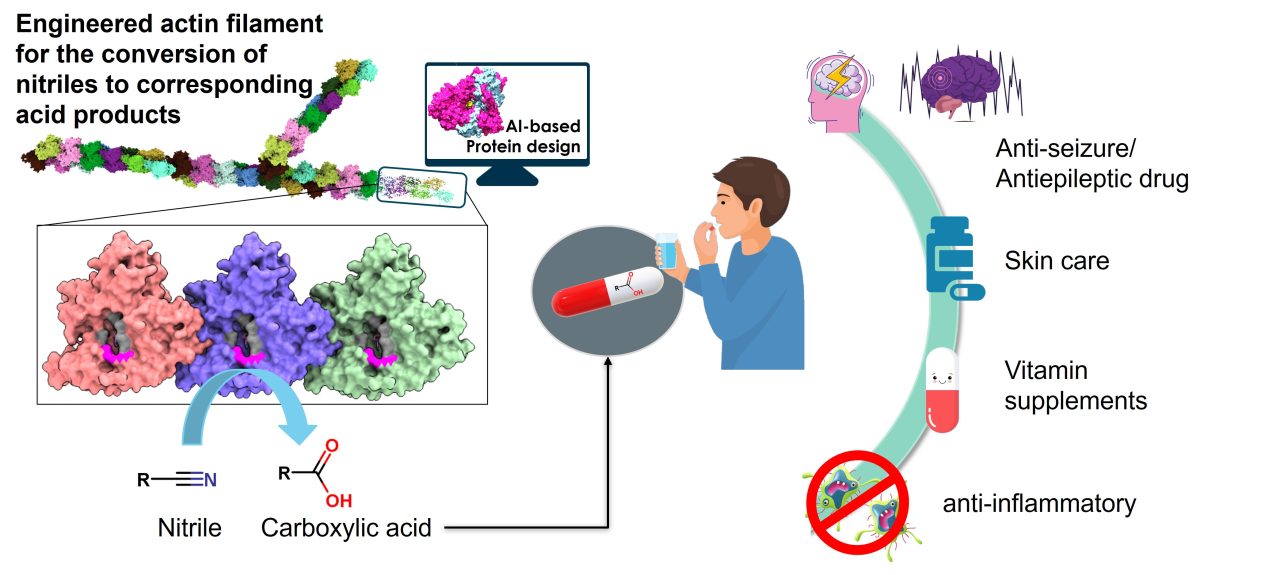
The functional repurposing of structural proteins offers exciting opportunities for sustainable and efficient biocatalysis. This study presents the engineering of two structural proteins, F-actin, to exhibit nitrilase activity, enabling the conversion of 1-(cyanomethyl)cyclohexane-1-carbonitrile into 2-(1-cyanocyclohexyl)acetic acid, a key intermediate in the production of gabapentin. By introducing catalytic residues adapted from nitrilase enzymes, these engineered proteins achieve robust and reusable enzymatic performance, overcoming the limitations of conventional nitrilases. The engineered F-actin retains its inherent surface adhesion properties, functioning as a self-immobilised enzyme that enables multiple catalytic cycles without significant loss of activity, selectivity, or yield. This stability addresses key drawbacks of traditional nitrilases, including their lability and limited reusability. The engineered proteins exhibit superior catalytic reusability and substrate specificity, effectively expanding the operational stability and efficiency of nitrilase functions. By integrating long-lived structural proteins with enzymatic activity, this approach eliminates the need for external immobilisation methods, reducing costs and enhancing sustainability. These engineered proteins hold significant potential for industrial biocatalysis, including pharmaceutical synthesis, agrochemical production, and other fine chemical processes. This work demonstrates a transformative strategy to merge structural protein engineering with enzymatic catalysis, providing a new class of stable, reusable, and efficient biocatalysts for industrial applications.
Patent No.: 567907
Date of grant: 26-06-2025