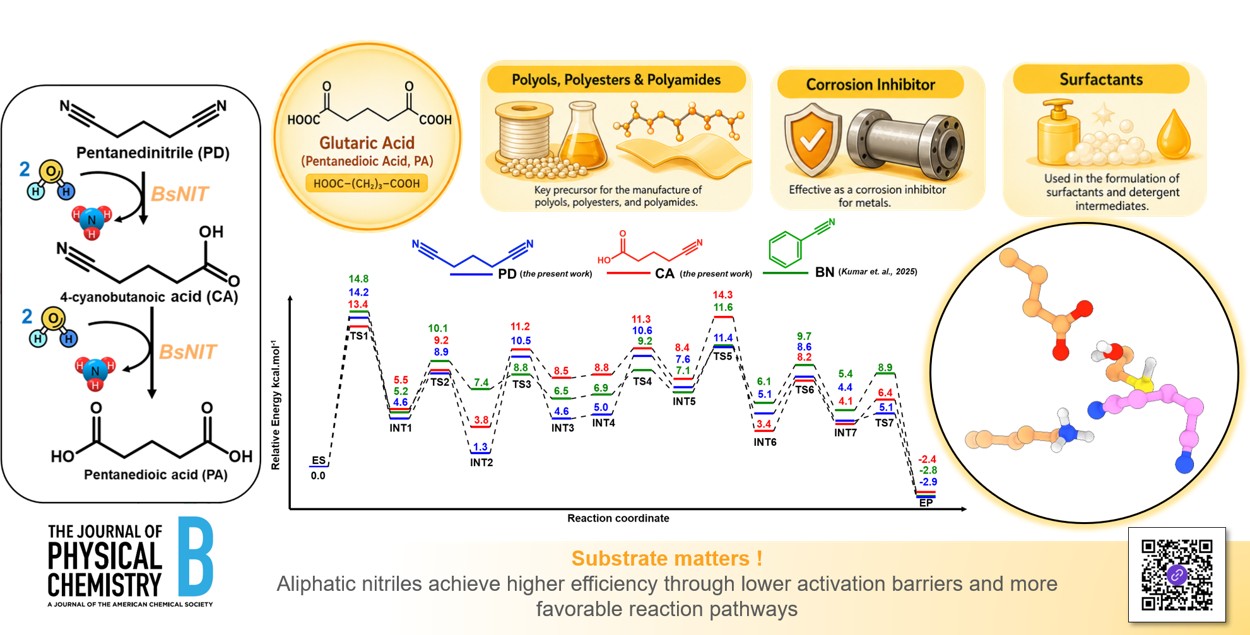
This study employed quantum mechanical dynamics (QMD) simulations to elucidate the catalytic mechanism of Bacillus safensis nitrilase (BsNIT) toward pentanedinitrile (PD). The results revealed a sequential conversion of PD to 4-cyanobutanoic acid and subsequently to pentanedioic acid through two water-mediated hydrolysis steps involving the catalytic triad (C164, K130, and E38). Key intermediates and transition states were identified, providing detailed insight into the reaction pathway. Comparative analysis with benzonitrile (BN) showed lower activation energy barriers for aliphatic substrates, highlighting their enhanced reactivity. These findings advance the understanding of nitrilase catalysis and support the rational engineering of BsNIT for industrial biocatalytic applications.
Highlights:
- This study elucidated the complete BsNIT-catalyzed hydrolysis pathway of pentanedinitrile using QMD simulations.
- Key intermediates, transition states, and water-mediated proton-transfer mechanisms were identified.
- Aliphatic substrates showed lower activation barriers than benzonitrile, explaining their higher catalytic efficiency.