HomeCategory

Scientific Posts

June 15, 2026
AN ARTIFICIAL INTELLIGENCE METHOD TO PREDICT SELECTIVITY OF TRANSAMINASES AND ENANTIOMERIC EXCESS OF TRANSAMINASE-KETONE REACTIONS

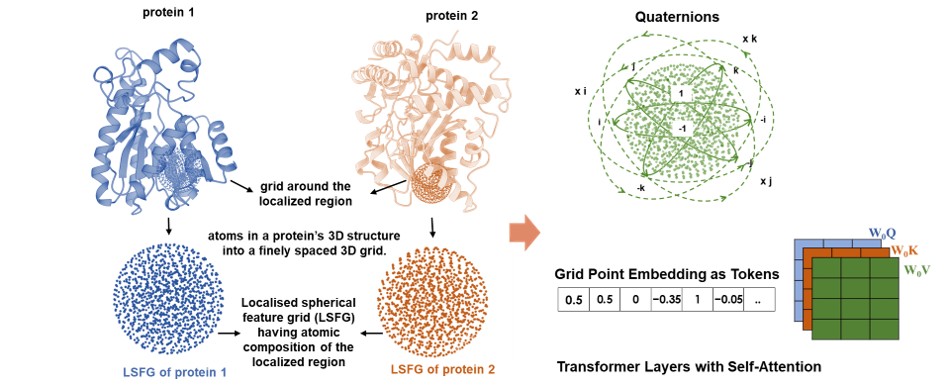
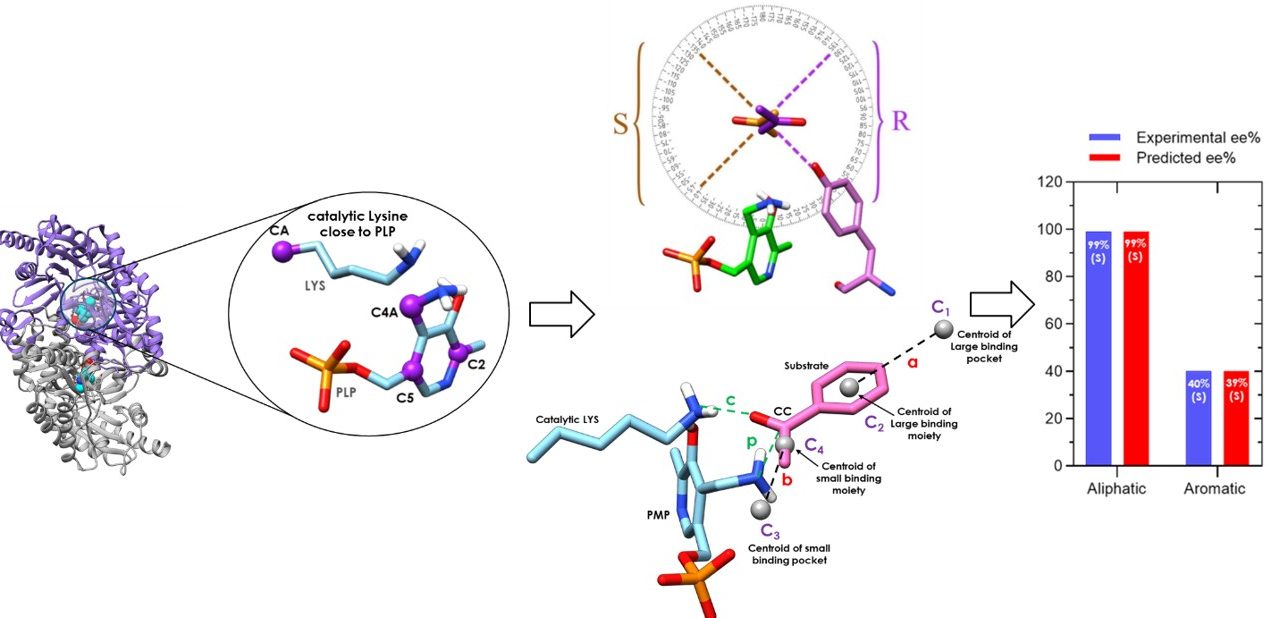
The present invention describes identifying if a given Transaminase is (R)-Selective or (S)-Selective. Based on the binding of the substrate in the active site of a given transaminase, it is primarily based on torsion, the angle between specific atoms of the cofactor PLP and the catalytic Lysine, and the ten interactions of the substrate with...

June 26, 2020
A Receptor Dependent-4D QSAR Approach to Predict the Activity of Mutated Enzymes

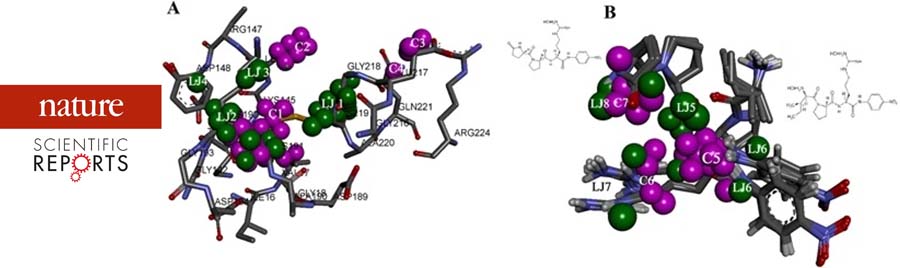
Screening and selection tools to obtain focused libraries play a key role in successfully engineering enzymes of desired qualities. The quality of screening depends on efficient assays; however, a focused library generated with a priori information plays a major role in effectively identifying the right enzyme. As a proof of concept, for the first time,...

June 24, 2020
Mechanism of  Phytochemicals : Affects the Polymerization and Depolymerisation of Actins

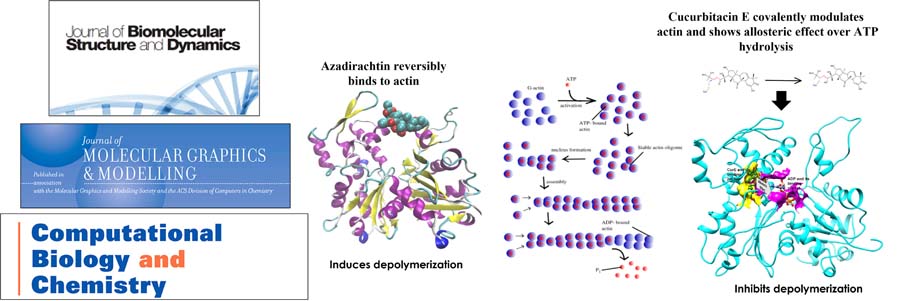
Mechanical understanding of the correlation between actin assembly and ATP hydrolysis has been an object of intensive studies in biochemistry and structural biology. Azadirachtin(A) (AZA), a potential insecticide from neem, binds to actin and induces depolymerization in Drosophila. AZA binds to the pocket the same as that of Latrunculin A (LAT), but LAT inhibits actin...

June 16, 2020
Engineering Enzymes for Improved Activity at Varying Concentrations of Substrate and Organic Solvent

One of the major problems in the use of enzymes in the industry is their instability under strict process conditions. As the use of organic solvents in industries for hydrophobic substrate solubility or the suppression of water-dependent reactions has become inevitable, the need to engineer enzymes to accommodate the varying solvent conditions and high substrate...

June 17, 2020
Insight Into Cholinesterase Inhibitors Mechanism By Car–Parrinello Ab Initio Molecular Dynamics In Conjunction With Metadynamics

The current study demonstrates the significant progress made in computational enzymology and exemplifies the power and advantages of employing CPMD simulations in characterizing enzyme mechanisms. Here Acetylcholinesterase inhibitors such as Rivastigmine, Physostigmine, Neostigmine, and Edrophonium binding mechanisms were explored through the metadynamics approach. (In Preparation)

May 13, 2022
Identification Of Hotspots And Derive Substitution For These Hotspots To Make Enzyme Variants And Screening These Enzyme Variants With Deep Learning Using A-CNN To Derive Top 5 Enzyme Variants With Desired Kinetic Property

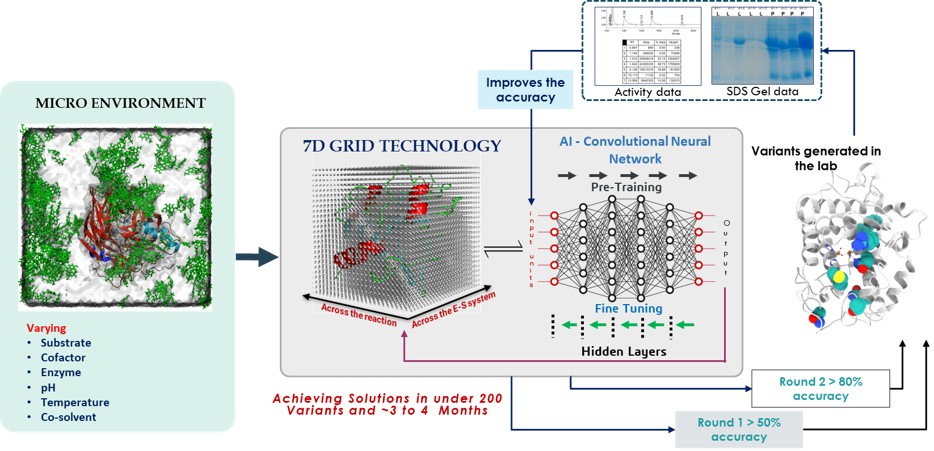
The invention is specific to the engineering of enzymes. The Michaelis Complex of E-S reaction is simulated using QM/MM, and MD methods. Using the QM polarized grid maps, MMPBSA. MMGBSA, low energy ES conformations that lead to the formation of attack conformation are identified. Subsequently, the enzyme is designed around the Michaelis complex where the...

April 16, 2021
Swiss model becomes 25 now!

Congratulations Swissmodel for completing 25 years of service!An excellent and powerful protein modeling server, the first ever modeling server since 2002. Modeled 1000s of protein, cytoskeletal proteins like tubulin, actin, and enzymes for engineering studies like Penicillin G Acylase. A tool that can be used for teaching and as well for research purposes.

March 23, 2021
Quantum Tunnelling!

Kcat Enzymatic we are working on the similar reactions of Cytochromes as in the Nobel Laureate Dr. Arnold’s lab, however by a different technology that uses Quantum Molecular Dynamics. We wonder if enzymatic reactions take the aid of quantum tunneling effects; specifically, could it be heavy atom tunneling! A quantum mechanical phenomenon where particles penetrate...